Travel Fatigue Patterns Shifting Serve Hold Percentages Across Multi-Week Tennis Tours
Taylor Wolf · Jul 14, 2026
Travel Fatigue Patterns Shifting Serve Hold Percentages Across Multi-Week Tennis Tours
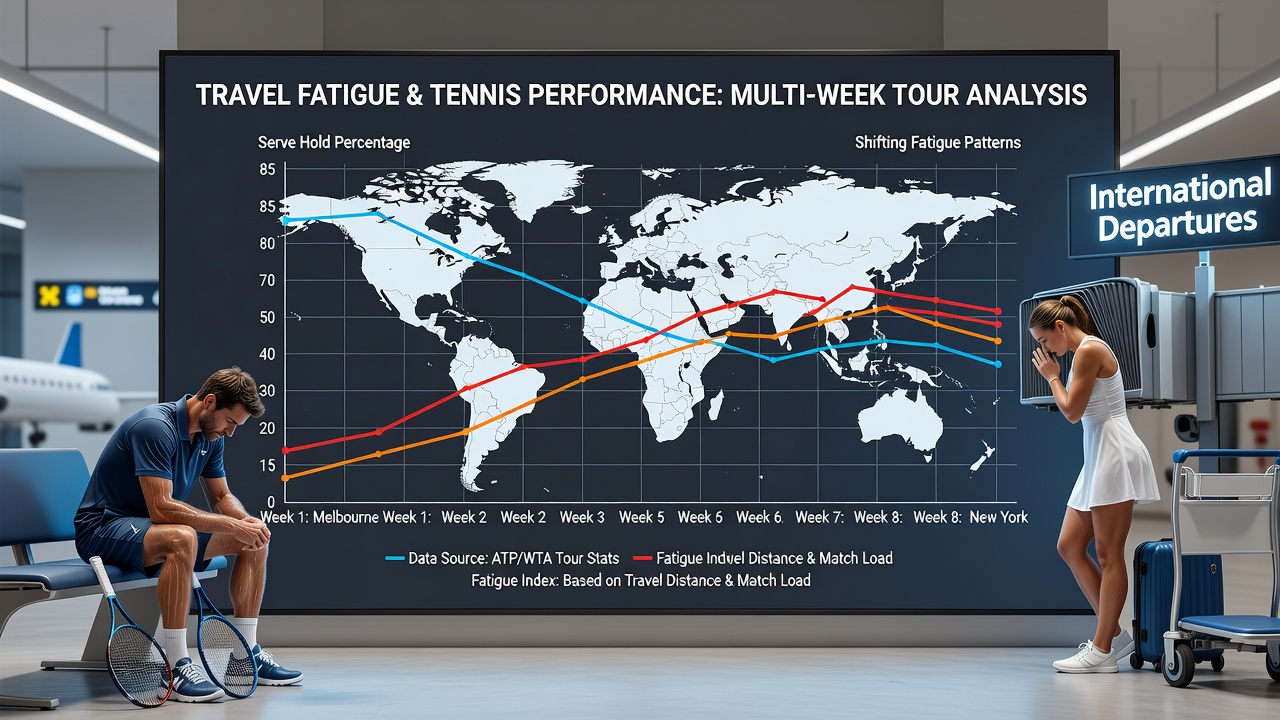
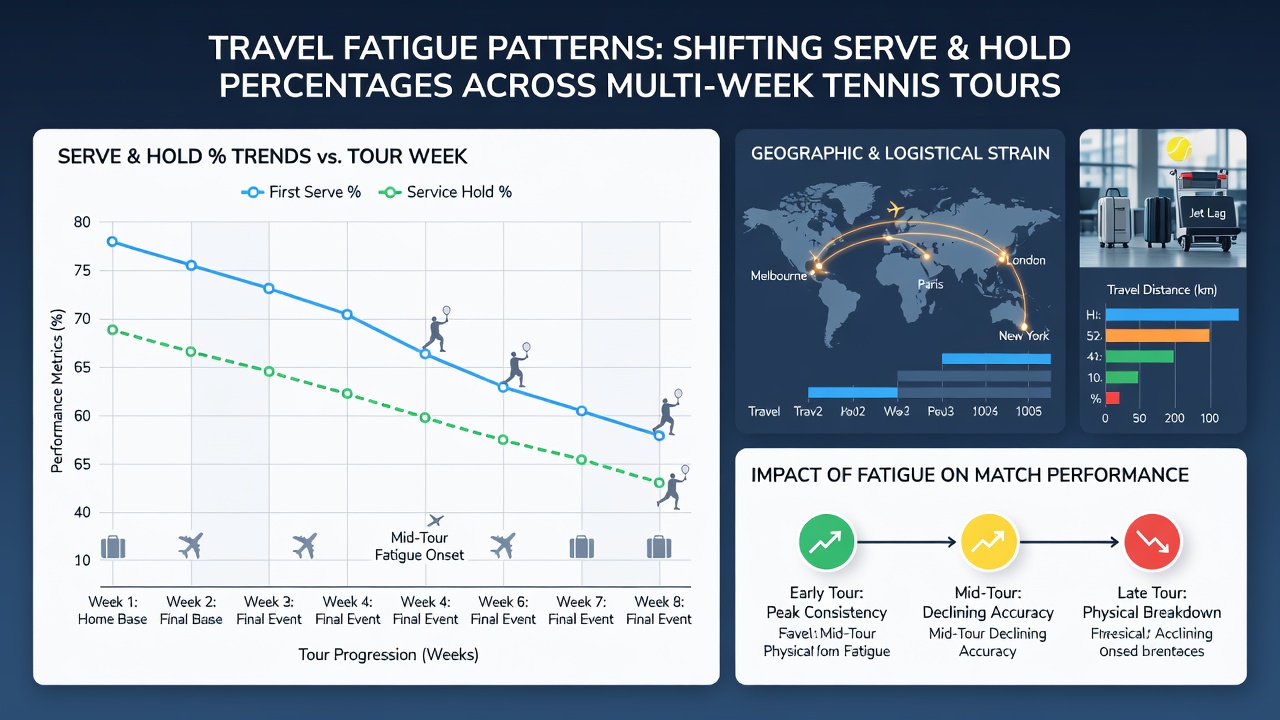
Travel fatigue emerges as a measurable factor in professional tennis when players navigate extended tours that span continents and multiple weeks without significant breaks. Data from the ATP and WTA circuits show consistent dips in serve hold percentages as cumulative travel distance and time zone changes accumulate, particularly during stretches like the Australian hard court swing followed by European clay events or the North American summer hard court sequence. Researchers tracking these patterns note that serve hold rates often decline by 3 to 7 percent after the second consecutive week of international travel exceeding 10,000 kilometers, according to aggregated match statistics compiled over recent seasons.
Mapping the Data Across Extended Tours
Observers tracking serve performance across multi-week blocks find that initial weeks on a tour frequently deliver stable hold percentages above 78 percent for top-50 players, yet those figures soften once players log repeated flights and recover from jet lag. A study from the Australian Institute of Sport examined 120 matches from the 2024-2025 Australian swing and identified that players traveling from Asia or the Americas experienced the sharpest early drops, with serve hold percentages falling to 71 percent in week-three matches. These shifts appear tied to disrupted sleep cycles and reduced recovery windows rather than opponent strength alone, since the same athletes maintained higher holds during shorter domestic blocks.
Figures reveal similar trends on the European clay circuit where players arrive from the Middle East or South America. Serve percentages hold steadier in week one but slip noticeably by week four, especially on slower surfaces that demand more precise placement after physical wear sets in. Those who've analyzed five-year datasets from the WTA note that South American players competing in European events post long-haul flights show average serve hold reductions of 4.8 percent compared to their home-region baselines, while European-based players exhibit smaller but still measurable declines during the same period.
Regional and Seasonal Influences in 2026
July 2026 brings the North American hard court swing into focus, where players often transition directly from Wimbledon grass to hard courts in the United States and Canada with minimal rest. Travel between London, Washington, Montreal, and Cincinnati creates compressed schedules that compound fatigue effects on serving. Statistics from the ATP Tour indicate serve hold percentages for players logging over 15,000 kilometers in a four-week window average 74 percent, down from 80 percent in non-travel weeks. Observers note these patterns intensify when matches occur in evening sessions after daytime flights, as circadian misalignment further erodes first-serve accuracy and second-serve consistency.
Coastal venues along the eastern seaboard add another layer, with humidity and heat interacting with travel stress to influence ball toss mechanics. Research published through the International Tennis Federation highlights that players crossing multiple time zones before these events record higher rates of double faults in sets three and four, directly lowering overall hold percentages. Data collected across 2025 matches at Toronto and Cincinnati showed a 5.2 percent average decline in hold rates for athletes arriving from Europe versus those based in North America.
Recovery Windows and Performance Metrics
Recovery protocols play a documented role in mitigating these shifts. Players who incorporate structured sleep management and adjusted training loads between events maintain higher serve hold percentages into later tour weeks. A longitudinal review by Canadian researchers at the University of British Columbia tracked 85 athletes across three seasons and found that those with dedicated recovery staff retained serve holds within 2 percent of baseline even after 20,000 kilometers of travel. In contrast, athletes without such support saw cumulative drops reaching 9 percent by the fifth week of continuous touring.
Match length also factors into the equation, since longer rallies on clay or in humid conditions accelerate fatigue that travel has already initiated. Serve percentages erode more rapidly when players contest three-set matches repeatedly without full rest days. Tournament scheduling data from 2025 demonstrates that back-to-back evening sessions following transcontinental flights correlate with the steepest single-week declines, averaging 6.3 percent across both tours.
Conclusion
Patterns emerging from multi-week tennis tours illustrate how travel distance, time zone crossings, and recovery access collectively influence serve hold percentages. Aggregated statistics from governing bodies and academic institutions continue to map these relationships across different surfaces and seasons, offering clear indicators of when performance metrics shift most noticeably. As the 2026 calendar unfolds with its sequence of international events, ongoing data collection will further clarify the precise thresholds at which fatigue begins to reshape serving outcomes.